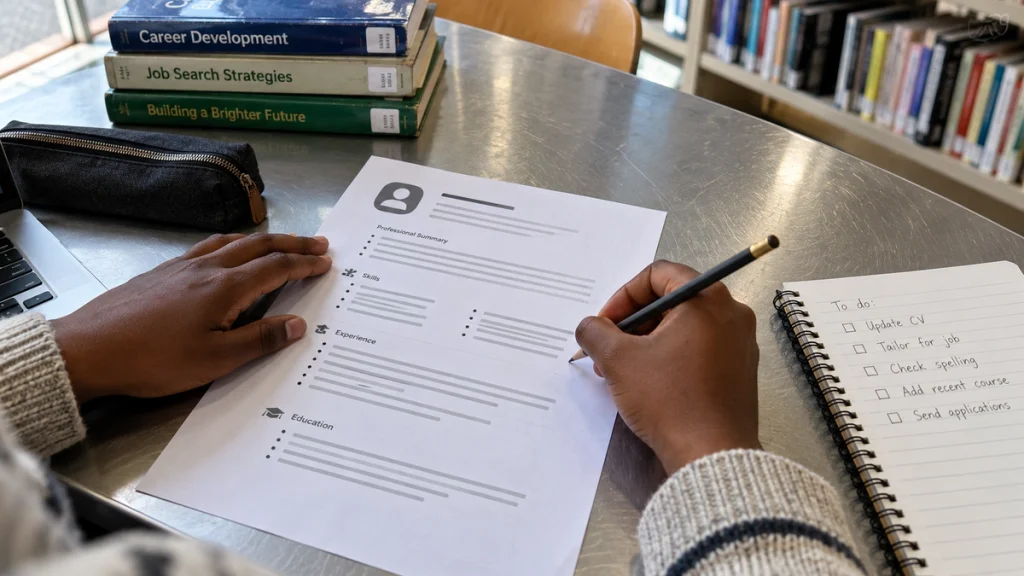
A blank employment section can make a first CV feel impossible. Yet a person who has organised a school fundraiser, helped with family orders or completed a practical course may already have evidence of useful work. The challenge is to describe that evidence accurately without pretending it was a formal job.
This guide is for South African applicants building a CV without formal work experience. It focuses on the actual writing: choosing evidence, describing responsibility, organising a readable document and checking every claim. The examples are fictional illustrations, not suggested achievements to copy into your own history.
Start with the work the vacancy actually requires
Choose one suitable vacancy before writing your profile. Read its duties and separate them into tasks, tools and conditions. A reception vacancy might involve recording messages, handling bookings and communicating clearly. Those requirements tell you what evidence to look for. They do not justify calling yourself an experienced receptionist if you have never done that work.
Mark each requirement as supported, partly supported or currently missing. For example, you may have handled enquiries at a community event but never used the employer’s booking system. Your CV can demonstrate the first skill and state your actual software knowledge. A cover letter can explain your interest in learning the unfamiliar system.
Avoid treating the advertisement as a bag of keywords. Repeating every phrase can make the document sound relevant while concealing weak evidence. Instead, choose three requirements you can explain with real examples. If the role requires a compulsory qualification you do not have, check whether an alternative is explicitly accepted before investing hours in rewriting.
If you still need a suitable vacancy, use the broader South African job-search guide first. A targeted CV works best when the opportunity itself is appropriate for your circumstances.
Build an evidence list before choosing a layout
Open a separate note and record activities from education, volunteering, community groups, caring responsibilities and informal paid work. For each activity, write the dates, your role, the people involved, what you actually did and what changed because of it. Keep this evidence list longer than the final CV.
Ask concrete questions. Did you maintain a register? Explain instructions to someone? Correct an error? Prepare materials before a deadline? Coordinate a handover? These actions are more useful than labels such as hardworking or passionate because an interviewer can ask how you performed them.
The UK National Careers Service provides a useful overview of CV sections, including education and experience. Use it as a structural reference, while following the particular employer’s instructions and local application requirements. It is not a rule that every South African CV must use one fixed layout.
Do not include private family details merely to prove responsibility. You can describe scheduling and organisation without disclosing another person’s health information. Likewise, obtain permission before using a community member’s contact details as a reference. Evidence should make your work understandable without exposing somebody else’s personal life.
Label informal experience honestly
An accurate heading helps a reader understand what kind of experience they are seeing. You might use Community Experience, Practical Projects or Informal Work. Under it, identify the activity and your contribution. Helping a relative with weekend orders is different from being a full-time operations manager, even if some tasks overlap.
Consider a fictional applicant, Sipho, who helped a neighbourhood football club prepare match-day equipment. His first draft says: “Operations leader responsible for logistics.” That title exaggerates his authority. A clearer entry says: “Volunteer equipment assistant, community football club,” followed by the actual months involved.
His bullets could describe checking equipment against a list, telling the organiser when items were missing and packing materials for the next session. If he did those tasks independently, he can say so. If an organiser checked his work, that context should remain clear.
Do not convert occasional activity into continuous employment by stretching dates. If you volunteered on selected weekends, describe it that way. There is no need to apologise for a small contribution, but its scale must be believable. A modest, defensible example gives an interviewer more confidence than an impressive title that collapses under a follow-up question.
Turn duties into evidence without inventing numbers
A useful CV bullet usually identifies an action, its object and a relevant outcome or standard. “Recorded incoming orders in a shared notebook so collection details were available to the next helper” is more informative than “Responsible for administration.” It explains both the task and why it mattered.
Numbers can help when you actually know them. They are not compulsory. If you cannot verify how many customers you assisted or how much time you saved, do not estimate a flattering percentage. Describe the process, frequency or observable result instead. “Checked each form for missing contact details before handing it over” can be credible evidence of care.
Write several rough bullets, then remove words that add no information. “Successfully and efficiently assisted with various important tasks” tells the reader almost nothing. Replace the adjectives with the task itself. Keep the distinction between your contribution and the team’s result, especially in a group assignment.
For each finished bullet, ask: could I explain this in an interview, describe a difficulty and identify someone or something that supports it? You do not need to attach proof to every application. The question simply protects you from writing claims that sound polished but are disconnected from what happened.
Make education and projects useful to the reader
List your qualification accurately, including whether it is completed or in progress. Add relevant modules only when they help explain your suitability. A long list of every subject can hide the practical evidence an employer needs. Where an application asks for a particular result or certificate, provide it through the requested process.
A practical project deserves a short description of the problem, your part and the output. Suppose you created a stock worksheet during a course. State that it was a course exercise using sample data. Explain whether you entered records, checked formulas or summarised the result. Do not present simulated data as a real company’s confidential inventory.
Choose a project you can discuss rather than the most elaborate group project you barely contributed to. Keep your original notes or a clean sample available if a verified employer asks. Remove classmates’ names and private details before sharing anything publicly.
Applicants combining local opportunities with a neighbouring market may find the Ghana job-search planning guide useful for organising applications and practical evidence. The CV itself should still reflect your own location and the requirements of the actual vacancy, rather than implying experience or eligibility in another country.
Write a short profile and a defensible skills section
Draft the profile last. Once the evidence is selected, summarise the kind of role you seek and the abilities you can support. For example: “Entry-level applicant with community-event experience in recording enquiries and preparing materials. Comfortable with basic spreadsheets and interested in a junior reception role.” Use this only as a pattern, not as a statement to copy regardless of your background.
Avoid an objective that could fit any person in any industry. A sentence about seeking a challenging opportunity to grow adds little unless it tells the reader what you can contribute. Equally, do not claim expertise because you have watched a tutorial. Describe your current level through tasks you can perform.
Group skills sparingly. Under digital skills, name tools and functions you have actually used. Under communication, point to an experience entry that demonstrates listening or explaining. A row of stars rating yourself on teamwork has no shared meaning and can waste valuable space.
When applying internationally, check expectations for that market as well as eligibility. The guide for international UK applicants separates application preparation from sponsorship and work-right research. A well-written profile should never imply that a CV alone resolves those separate questions.
Check readability, privacy and the exported file
Use clear section headings, consistent dates and enough spacing to distinguish entries. Choose a straightforward font that remains readable on a phone and a printed page. There is no benefit in squeezing unrelated information into tiny text. Let the strength and relevance of your evidence determine what stays.
Follow the employer’s requested file type. When PDF is accepted, export it and reopen the actual file you will send. Check page breaks, missing characters, cut-off lines and whether your contact information appears correctly. Copy a sentence into a plain text editor to see whether the text is selectable and in a sensible order.
Use a professional filename such as your name followed by CV and the role family. Keep private revision labels out of the attachment name. Make sure the email address and telephone number belong to you and are checked regularly. Do not add identity numbers, bank information or unrelated personal documents simply to make the application look complete.
Ask a trusted reader to locate your strongest evidence within a short scan. If they notice decorative elements before your relevant experience, simplify the layout. If they cannot explain what you personally did, improve the wording rather than adding another design element.
Use this final first-CV checklist
Before sending, compare the document with the original vacancy one more time. A good edit is not merely a spelling check; it tests whether every major claim is useful, accurate and easy to find. Read the document aloud if possible. Awkward sentences often become obvious when spoken.
- The profile identifies a relevant role and supported abilities.
- Informal work, volunteering and course projects are labelled correctly.
- Dates and qualification status are accurate.
- Each selected bullet explains something you personally did.
- Numbers are supported, and team results are not claimed as individual achievements.
- Contact details work and unnecessary personal information is removed.
- The exported file opens correctly and follows the application instructions.
- A saved copy records exactly what the employer received.
Keep the evidence list after sending. When you complete a new project or take on a new responsibility, add it there first. This gives you a reliable source for future applications and interviews. You can then tailor a CV without repeatedly rebuilding your history from memory.
Do not rewrite the entire document after every unanswered application. Look for a pattern across suitable roles, seek specific feedback where available and improve the weakest evidence. A first CV is a working document that becomes stronger as your experience grows.
Frequently Asked Questions
Can I include unpaid activities?
Yes, when they show relevant abilities and are described honestly. State that the work was voluntary or part of a community activity. Explain your tasks and contribution without inventing a formal employment relationship or senior title.
What if I have no numbers for my achievements?
Use observable actions and results. Completing a register accurately, preparing materials before a session or correcting an identified error can all provide evidence. Do not create percentages because an online template suggests every bullet needs one.
Should I include every course certificate?
Usually, prioritise the training relevant to the vacancy and follow any explicit document request. A list of unrelated short courses can distract from the qualification or project that actually supports the role. Keep the full record privately for future use.
How do I make my CV stronger this month?
Choose one missing task skill and complete a small, honest practice project or suitable activity that develops it. Record what you did, ask for feedback and update your evidence list. Improvement comes from clearer proof of capability, not from making your job titles sound more senior.
